The Historic Adams Farm: 200 Years of Agriculture & Ancestry in Holly Springs
Contributed by David P. Adams
Anchoring the Town’s southern gateway along NC 55 sits a beacon to the Town of Holly Springs’ rich agricultural history - once predominantly a farming community. The Historic Adams Farm dates to the early 1800’s when James and Elizabeth Adams settled in the area to farm and begin raising their family. At the peak of its glory, the Historic Adams Farm once encompassed more than 500 acres and stretched approximately from Ralph Stevens Road (modern day Lowe’s) on the north to Wade Nash Road on the South, and east along Basal Creek to the headwaters of Bass Lake (formerly Mills’ Pond). While the farm has been subdivided over the years due to generational transfers, and as a result, many parcels of it have been developed, 6th and 7th generations of the Adams family still live and steward what remains of the farm today. The NC Department of Agriculture has granted The Historic Adams Farm the distinguished designation of being a NC Bicentennial Farm (200+ years in direct lineal ownership/stewardship) – and it is the only NC Bicentennial Farm within the Town of Holly Springs city limits and/or extra-territorial jurisdiction (ETJ).
Originally a row crop farm, the farm once produced commodities including tobacco, cotton, sweet potatoes, corn, peanuts, soybeans and saw timber. Due to the region’s explosive growth over the last several decades and the numerous challenges that small family farms face today, the remaining farmland has primarily been transitioned to hay production for livestock and timberland.
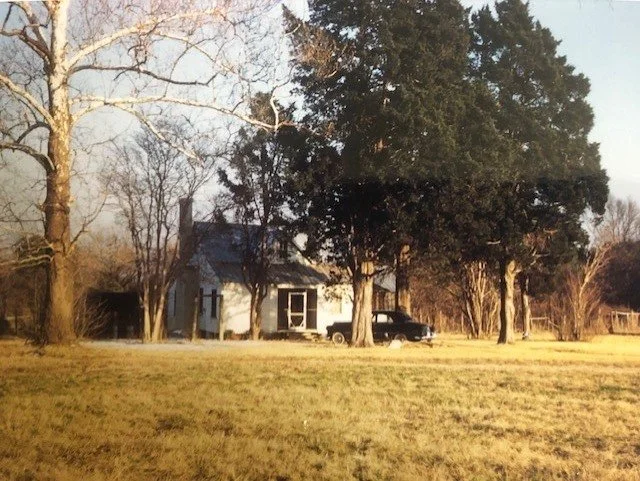
James Adams (1805-1885) left his family home as a young teenage boy in the early 1800’s to pursue his dream of living an independent agrarian life. Upon marrying Elizabeth Avery Adams (1807-1885) of Cumberland County, the two of them built a modest 2-room Federal “coastal cottage” style house where they raised seven children. Constructed between 1820-1830, the original Adams homestead still survives today, along with several outbuildings including a detached kitchen, 2 smokehouses, a tack building and a chicken coop. In Kelly Lally’s book entitled The Historic Architecture of Wake County North Carolina, the Adams House is described as “one of the oldest dwellings in southwestern Wake County.”
In addition to the family’s farming activities, James Adams was instrumental in helping to establish the very first school in 1853, The Holly Springs Academy (before Holly Springs was incorporated), and served the community in many other various capacities. James and Elizabeth Adams are buried in the Adams Family Cemetery located on the farm directly across Highway 55 (west side) from their original homestead.
While all of James and Elizabeth Adams’ children made their own respective contributions to the community, their most renowned descendant was Lt.-Colonel James Theophilus Adams (1839-1918). Born on September 7, 1839, young James Theophilus (nicknamed “Thee” in his later years) followed in his father’s footsteps and began farming at an early age. As hostilities between the North and the South continued to escalate, causing North Carolina to vote to secede from the Union on May 20, 1861, James and his older brother, David Columbus Adams, both answered the call in defense of their homeland. While David chose to initially join Company G, 1st Regiment N.C. State Troops, he would later be reunited under the leadership of his younger brother James T. in 1863.
On May 29, 1861, at the tender age of twenty-one, James T. Adams gathered just a few personal belongings and walked to the center of Town – full of courage yet unable to imagine the depravity and the horrors the next four years would entail. Along with a significant number of other young males similar in age from Holly Springs, the volunteers mustered into service as Company D, 26th Regiment N.C. State Troops. Known as the “Wake Guards,” the company remained in Holly Springs and began to train intensively. After several weeks and under the leadership of a 28 year-old Captain named Oscar R. Rand (James T. Adams being initially appointed 2nd Lieutenant), the “boys” of Company D from Holly Springs marched to Raleigh on July 16, 1861 and joined Companies A, B, C, E, F, G, H, I, & K from across other regions of North Carolina to officially form the renowned 26th Regiment N.C. State Troops. In its infancy, the 26th NC Regiment was led by Colonel Zebulon Baird Vance – who would later resign from military service in May 1862 to become the Governor of North Carolina for the war’s entirety. Vance would go on to serve another term as Governor from 1877-1879.
As part of Robert E. Lee’s Army of Northern Virginia, the men of the 26th NC Regiment spent the first winter of 1861 in defense of the State’s coastal fortifications in and around Morehead City, Beaufort, Bogue Banks (Fort Macon), and New Bern. As the eastern theater of war became concentrated in Virginia, the 26th N.C. Regiment moved north to participate in practically every major battle in 1862. Due to its constant and tenacious daily drilling, combined with its steadfast courage and battle-proven success, the 26th NC Regiment soon garnered a reputation as one of the finest regiments on either side of the entire Civil War.
Having recently been promoted to Captain on April 21, 1862, James T. Adams was seriously wounded in the hip at the Battle of Malvern Hill, VA on July 1, 1862. After partially recuperating from his wounds while on a short furlough in a field hospital, James T. would return to duty in October of that same year.
Little could he comprehend that exactly one year from the date of being shot at Malvern Hill, Captain Adams and the 26th N.C. Regiment would etch their name in the history books in the most famous and bloodiest conflict ever to be held on American soil – The Battle of Gettysburg. Over the course of the next three days (July 1-3, 1863), the 26th N.C. Regiment fought with such gallantry that numerous books and periodicals have been written about the Regiment – the most prevalent entitled Covered With Glory (The 26th NC Infantry at the Battle of Gettysburg) by Rod Gragg.
Under the blistering July heat in the midst of some of the Battle’s fiercest fighting, Captain James T. Adams was again seriously wounded in the left shoulder on July 1 while engaging and routing the famed 24th Michigan “Iron Brigade.” Going into the battle with more than 800 men strong, the 26th N.C. Regiment suffered 588 dead and wounded in a single day (74%) – yet had succeeded greatly at overtaking and routing the Federals while fighting uphill along an area known as McPherson’s Ridge. As Captain Adams would later describe, “It seemed that the bullets were as thick as hail stones in a storm.” While seriously wounded yet again, Captain Adams was eventually removed from the field of battle and placed in a supply wagon for the eventual retreat. The tattered remnants of the 26th N.C. Regiment would take a much needed rest on July 2nd - only to find itself front and center yet again on July 3, 1863 for the famed Confederate assault known as the “Pickett-Pettigrew Charge.”
On Cemetery Ridge, across a 1-mile open field that bore human carnage like no other place in America, rests a small, humble granite monument to the 26th N.C. Regiment. With only a mere company’s worth of soldiers who had not been killed or severely wounded, the remnant of men of the 26th reached the “high water” mark of the entire famous assault – knowing their own chances for survival were practically nonexistent. After reaching the Federal line, yet unable to turn it back, the order to retreat was given to the last surviving & tattered soldiers of the 26th, thus bringing the Battle of Gettysburg to an end.
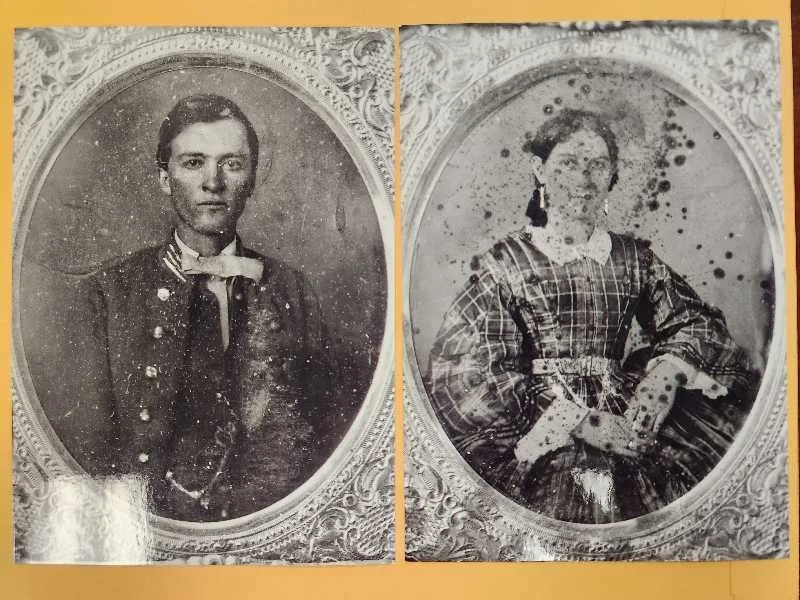
Upon returning to Holly Springs on yet another short furlough to try and recover from the wounds he suffered at Gettysburg, James T. Adams (who was promoted to Major following the Battle) would finally make the decision to marry the love of his life and “the girl he left behind” – Miss Lucy Ann Beckwith.
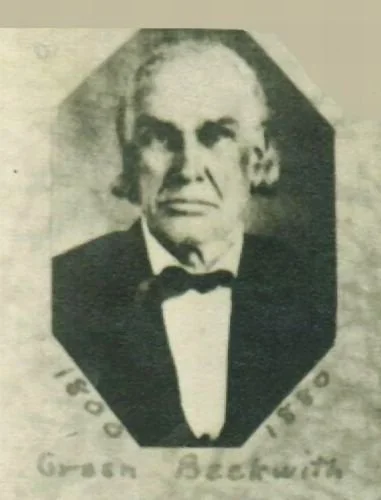
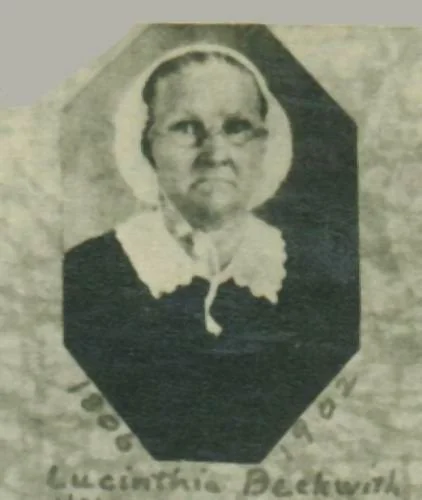
Lucy Ann Beckwith Adams (1844-1928) was the daughter of Green Beckwith (1800-1880) and Lucinthia Holland Beckwith (1806-1900). Green and Lucinthia Beckwith lived on a farm between Holly Springs and New Hill and they are buried in a small discreet family cemetery on the side of the Holly Springs New Hill Road across from the Shady Grove Baptist Church. Due to the friendship between Green Beckwith and James Adams and the fact that the two of them served on a number of boards related to the construction of school, church and civic organizations, it is no surprise that young James T. Adams and Lucy Ann Beckwith fell in love at an early age. It is purported in family lore that even though Lucy Ann wanted James T. to marry her before he headed off to war, he refused not wanting to leave his Lucy Ann widowed at such a young age. Having narrowly escaped death so many times and after being wounded twice, he decided to officially take her hand in marriage on September 28, 1863 while home recovering from his wounds. Their love story was portrayed in Angie Ottison-Staheli’s play Finding Patience– The Story of Holly Springs that played to consecutive sold out audiences in 2017 and 2022.
Shortly after getting married, and out of duty and commitment to his fellow soldiers who had survived, James T. Adams would return yet again to the 26th NC Regiment where he helped to reorganize the Regiment with additional men. Now just 24 years of age, James T. Adams would be promoted to Lieutenant-Colonel and serve until the remainder of the War. During the last months of the War, Lt.-Col. Adams was in command of the Regiment, and at times of the entire Brigade. He signed the paroles of each remaining soldier of the 26 N.C Regiment as a part of General Robert E. Lee’s surrender at Appomattox Court House, and he himself made the long journey home back to Holly Springs where he and his family would face the hardships of Reconstruction.
There are many stories and anecdotes of Lt.-Col. Adams’ bravery during various battles of the Civil War; however, one stands out in particular:
“At Hancock’s defeat at Burgess’ Mill, on the Boydton plank road south of Peterburg, 27 October, 1864, Lieutenant-Colonel Adams in command of the regiment, acted with such conspicuous gallantry as to call forth the warm commendation of his brigade commander, General William MacRae. The brigade with other troops were ordered to dislodge Hancock, who had cut through the Confederate lines. After being cut off from the other regiments and charging the enemy in its front with hand-to-hand combat, the troops captured a battery (of cannons). In this action, the flag-bearer of the Twenty-Sixth Regiment was either shot down in the charge or got beyond eyesight in the dense swamp and undergrowth through which the men charged. Lt.-Col. Adams, who had lingered behind to see what had become of his color-bearer, ran out between the lines, and thinking his men a little downcast at losing their colors, jumped up on a stump and called out, “Twenty-sixth, rally on your commander! He is here if his colors are lost!” The men responded with a cheer and a resounding victory on the field.
In the annals of military history, the sheer discipline, grit, courage, and sacrifice of the 26th Regiment N.C. State Troops can seldom be paralleled.
After the surrender at Appomattox Court House on April 9, 1865, Lt.-Col. Adams returned home to his family and farm to try to salvage what he could. While the modest Adams House itself had been spared by General William T. Sherman’s Army of thieves and arsonists, four years of neglect had taken its toll, and the Federal Army had stolen the majority of the livestock and equipment needed to start over. As a result of the many hardships, suppression, poverty and taxation brought about during the period of Reconstruction, James T. Adams and his brother, David Columbus Adams came within minutes of having the family farm sold on the courthouse steps in Raleigh. In fact, the original handwritten Trustee’s Deed signed by James and his brother David and their spouses remains in the family’s archives today.
Still suffering from the lasting effects of the wounds he received during The War, Lt.-Col. Adams and his wife, Lucy Ann, built and moved into a house off of Avent Ferry Road, located closer to the center of Town. Unfortunately, this house was torn down with the construction of the UNC Rex Hospital in Holly Springs. It has been said many times by a number of different family members that after Lt.-Col. Adams returned home from the War, he spoke little about his experiences. Instead of dwelling on the past, he chose to spend his time and efforts on reconciliation through his active involvement in the Holly Springs community – mainly serving in the Baptist Church and as Lodge Master of the Holly Springs Masonic Lodge No. 115 for five separate terms.
Lt.-Colonel James T. Adams died at the age of 79 on February 19, 1918. An article written on Lt.-Col. Adams in a national periodical stated, “The death of Col. James Theophilus Adams at his country estate, near Holly Springs, N.C., after a brief illness, denotes the passing of a prominent and valued citizen of Wake County who gallant service during the War Between the States marked him as one of the bravest of the brave who wore the gray. His going also marks the passing of one of Wake’s oldest and most representative families. He was a man of sterling qualities. Since the war, Colonel Adams had resided in Wake County, a prosperous man in business, loved, respected, and esteemed by all who knew him. For many years, he had to use crutches because of the wounds received in battle. Surviving him are his devoted wife, his constant companion to the end (Miss Lucy Ann Beckwith, of Wake County), also four sons and four daughters. The funeral was conducted with Masonic orders.”
Lt.-Colonel James T. Adams and Lucy Ann (Beckwith) Adams are both buried in the Holly Springs Town Cemetery.
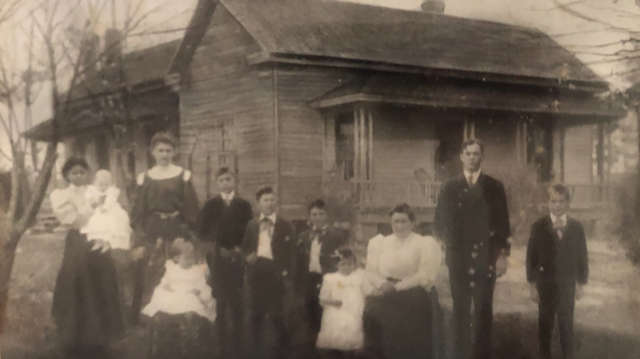
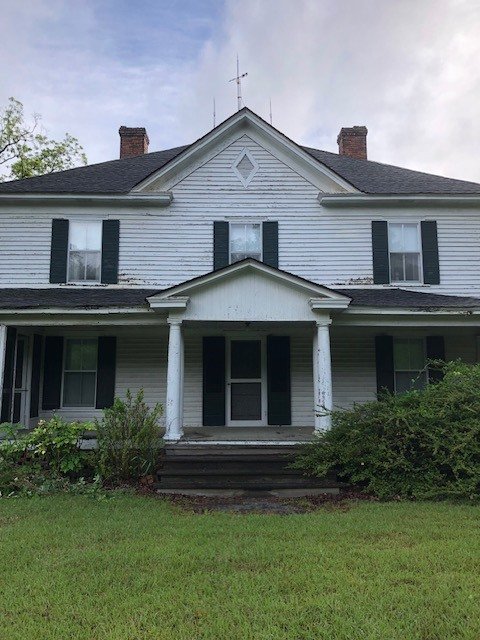
The oldest of nine children of James T. and Lucy Ann was born to them on July 6, 1866 – a daughter named Annie Lee. Annie Lee and her husband Richard Leonidus “Lon” Adams eventually made their way back onto the farm where they resumed the farming operations and expanded into the timber/lumber business. With a total of fourteen children (four of which died in their infancy), R. L. and Annie Lee Adams raised their family in a small single-story home they built on the west side of NC 55 Highway just a few hundred yards north of the family cemetery and the original homestead. After catching fire and burning to the ground in @ 1911-1912, R. L. and Annie Lee Adams commenced construction on a prominent 2-story Colonial Revival house bearing a tall hip roof, double chimneys, and a wrap-around porch. The house was completed in approximately 1913. Although deteriorating rapidly due to neglect since the death of its owner in 2013, the abandoned house and farmstead remain today and are a beloved landmark for both native and newcomer alike in Holly Springs.
Upon the death of R. L. and Annie Lee Adams in 1937 and 1940 respectively, three of their sons acquired and divided the farm while granting their siblings lifetime rights to live on the farm. While the parcel of land that contains the Richard and Annie Lee Adams home and farmstead is currently on the market to be sold and developed, three additional parcels remain and are being actively farmed today by members of the Adams family. One parcel contains the original homestead of James and Elizabeth Adams; one parcel contains the Adams Family Cemetery, and one parcel borders the Carl Dean Greenway running from Sugg Farm Park to Bass Lake Park.
While there are countless stories that have been told and passed down over the last 200+ years that connect generations of family and friends alike; without question, the Historic Adams Farm has long been a place where both young and old, male and female, Black and White have gathered together, worked together, socialized together and lived together all for the collective good of their beloved Holly Springs community. Only those who personally experienced it will ever truly know what it was really like to plow fields with a team of mules, hand-prime tobacco in the scorching heat of summer, kill hogs in the dead of winter, or attend a public baptism in Mills’ Pond (now Bass Lake), but whatever it was, they always did it together as a tight-knit community of folks who looked out for and loved one another.
-
![]()
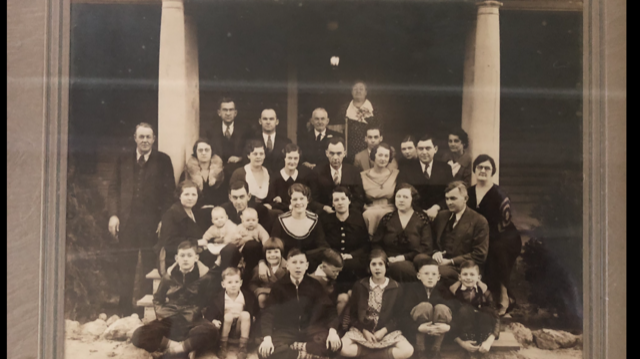
Adams Family 1935
-
![]()
Annie Lee Adams & Children in 1906
-
![]()
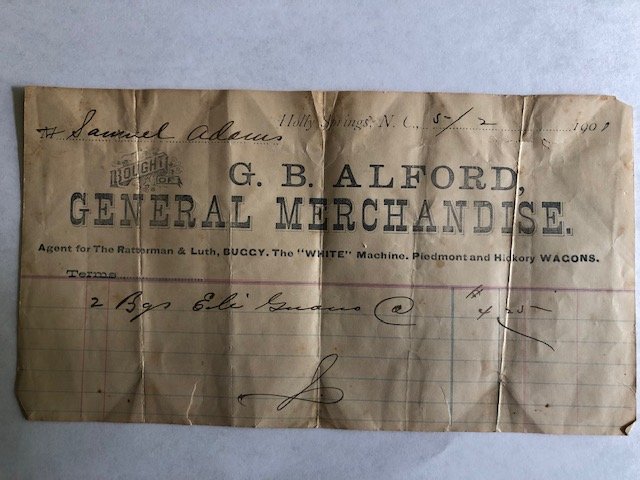
G.B. Alford Store Receipt in 1901
-
![]()
Green Beckwith
-
![]()
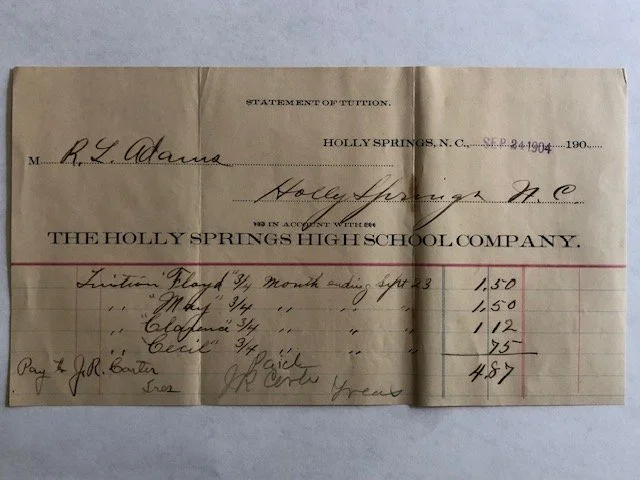
Holly Springs High School Company Tuition in 1904
-
![]()
James T. & Lucy Ann Adams in 1863
-
![]()
Lucinthia Beckwith
-
![]()
Original Adams Homestead (built circa 1820)
-
![]()
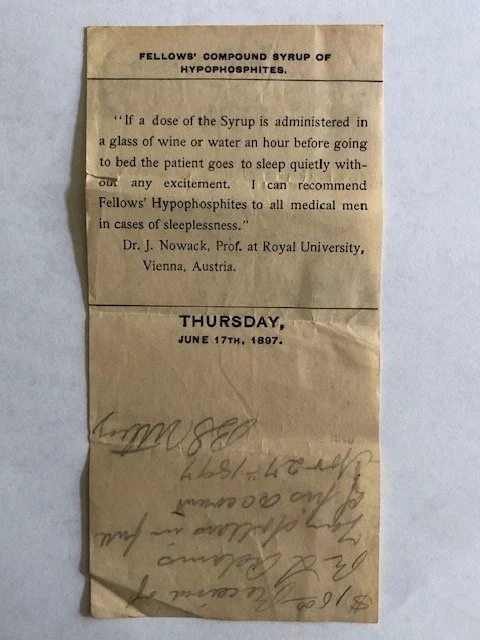
Receipt from Dr. Britton Suggs Utley 1897
-
![]()
Richard & Annie Lee Adams House (built circa 1913)