


Echoes in the Evergreen: The Holly Springs Cemetery
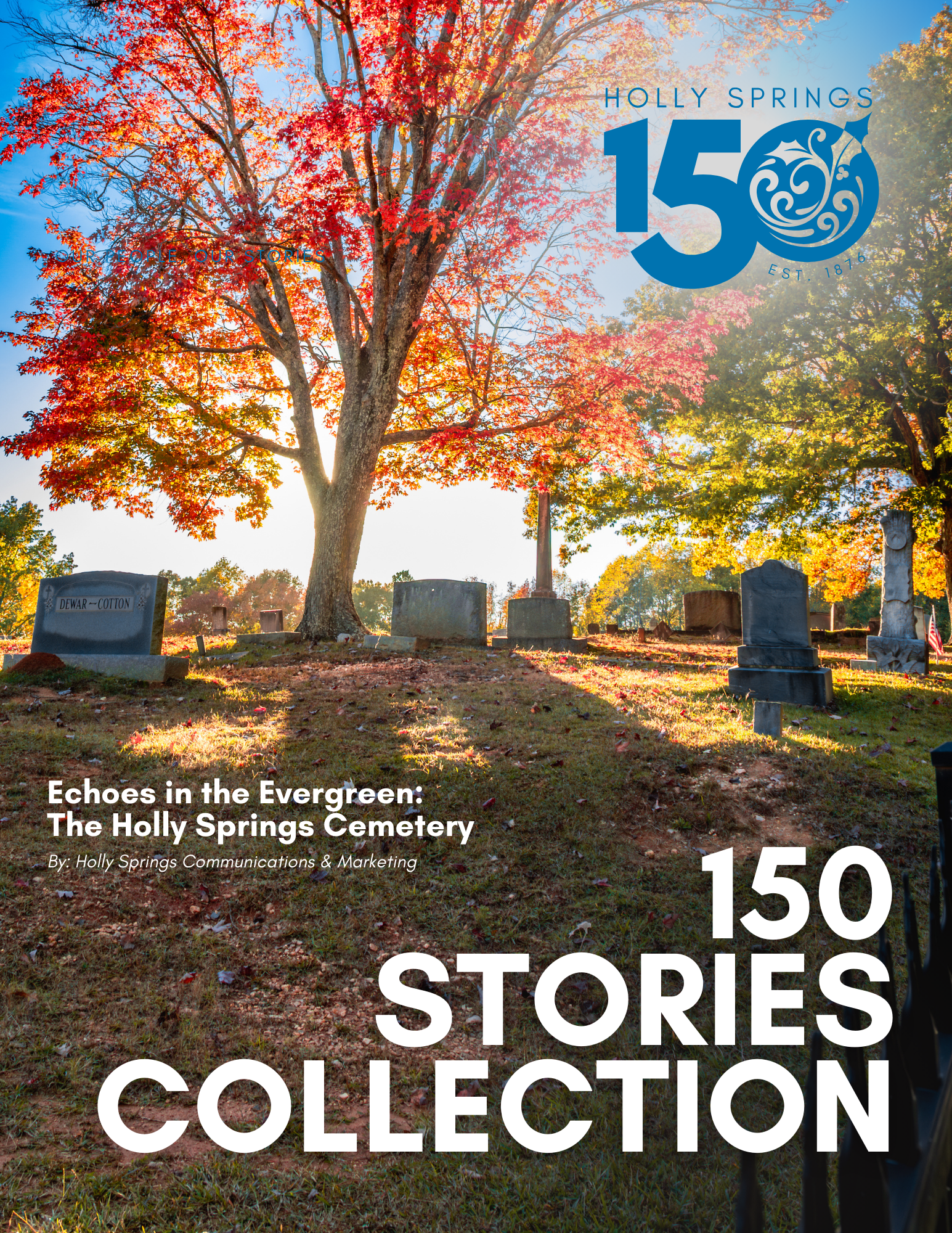
Baker, Ballentine, Brooks, Burt, Carter, Collins, Holleman, Holt, Jones, Mims, Sears, Shaw, Stevens, Utley, Womble: these names etched in stone are among others that are instantly recognizable. Walking through the Holly Springs Cemetery is like traveling through time and among the people who shaped the foundations and the future of Holly Springs. Each stone represents a life dedicated to the rewarding work of leading a growing community.
From Schoolhouse to Sanctuary
The land the cemetery now occupies at 451 W. Earp St. didn't begin as a final resting place. It was originally the site of an all-boys preparatory school and a church. Archibald Leslie, the original owner of the Leslie Alford Mims house, deeded land to the Holly Springs School in 1853 and the Holly Springs Church in 1855. The church’s portion of the land was deeded to the Town by Johnathan Burt and the other trustees of the Holly Springs Church in 1893. Another section of the cemetery was deeded to the Town by the Burt family in 1925 and includes the large Burt family plot near the cemetery entrance on the street that bears their name.
The growth of the Holly Springs Cemetery mirrored a social change sweeping across the nation at the time. While most agricultural families of the era still buried their dead on their own land, the mid-1800s saw a burgeoning desire for public, park-like spaces in cities and towns. Coupled with the growing practice of embalming bodies, this led to the rise of municipal cemeteries—places of both remembrance and reflection. The earliest Town records discussing the cemetery date back to 1909, with the earliest surviving survey from the 1920s.
In the early 20th century, elected Town Commissioners served in roles that are now fulfilled by department directors. One was the Cemetery Commissioner. The Commissioner would travel to the cemetery, sell graves, and mark headstones. In November 1909, all the commissioners were to meet at the cemetery to lay out plots. And in the 1920s, the Mayor called a special meeting to be held at the cemetery to discuss buying the plot of land from the Burt family. Today, the Town Clerk’s Office oversees the cemetery.
In 1927, a survey revealed that area resident E B Oldham’s property was located outside Town limits. However, Oldham had been paying Town taxes on the land. Instead of having the Town refund the money, Oldham agreed to accept a cemetery lot with room for about 16 burials. The lot can be found in section Iris 6.
Resting with the Founders
Walk the paths of the cemetery, and you are literally surrounded by the Town's lineage. Markers for no fewer than 14 former mayors of Holly Springs lie within these quiet borders. Their names include William “Buck” Wheeler, J. R. Carter, W. F. Shaw, Theo H. Wiggins, W. B. Collins, D. A. Baker, Carvin L. Massey, William L. Price, Irvin Gattman, Thurman B. Johnson, Ivan Collins Mims, Mallie Jack Stephesn, jr., James Norris, Sylvian Knowles Brooks, Gerald Holleman, Parrish “Ham” Womble, and Dick Sears. All served their Town in life, and in death, they form the heart of its history. Other “first families” well represented are the Beckwith, Collins, Earp, Holt, Jones, and Utley families. These were the merchants, pastors, doctors, and farmers who made Holly Springs.
Among the oldest marked burials are Arthur Branch, who died in February of 1852, and Thomas J. Bennett and Cass Holt, who were killed in the Civil War and laid to rest in 1862 and 1863, respectively. The cemetery also includes J. Oscar Earp, a Town Commissioner in 1893; members of the Utley family; and members of the Holt family, many of whom served the Town.
The Mystery and the Meticulous Record
Despite the cemetery’s age, the records are remarkably thorough. There are only a few, nameless graves where the Town knows someone is buried, but the identity has been lost to time.
To visit the Holly Springs Town Cemetery is to hold a quiet conversation with history itself. The public is invited to visit, to pay respect to those who shaped the Town's foundation, and to find a profound connection to the past.